How Metro bills SDOT for service

With Seattle and King County Metro renewing their partnership in the Transportation Benefit District, it’s interesting to track how the cost of service escalates over the years.

Metro bills SDOT based on actual expenses; SDOT pays an estimated cost and the the agencies reconcile the difference at the end of each year. There are three pieces to the City’s total bill:

  1. The actual cost of driving, maintaining, and fueling the buses;
  2. Amortization and depreciation of the buses themselves; and
  3. a credit for fares, based on the systemwide farebox recovery ratio.

Metro’s Jeff Switzer was able to give me the figures for 2019. They break down like this:

Continue reading “How Metro bills SDOT for service” | 17 comments

News roundup: why transit is expensive

Sound Transit Link About to Leave Mount Baker Station

This is an open thread.

76 comments

Sound Transit eyes phasing of ST3 projects

The Sound Transit Board on Thursday received several illustrative scenarios for prioritizing ST3 projects through the realignment required this summer because of tax shortfalls and cost overruns. The scenarios bookend the range of possibilities with delays on individual projects ranging from 1 to 14 years.

Among the scenarios is a phasing approach which would keep delays on the highest priority projects within the range of 2 to 4 years. Due to subarea constraints on Board action, some variation of the phasing approach seems the most likely to emerge from the realignment process.

Continue reading “Sound Transit eyes phasing of ST3 projects” | 108 comments

Metro unveils new service criteria

150 to Seattle off I-5

After an eventful 2020, Metro has been taking a look at how it prioritizes routes. As first reported by Stephen Fesler, On January 27th it briefed King County’s Mobility and Environment committee on its progress and revealed a bit about the staff’s thinking.

It appears Metro’s top two investment priorities will remain reducing crowding and improving reliability.

The current service guidelines describe how the third priority works: each corridor has a score based on the corridor’s ridership potential (“corridor productivity”, 50%), service to low income and minority neighborhoods (“social equity”, 25%), and connecting key nodes in the county (“geographic value”, 25%). The point total puts the corridor into one of four frequency levels. Metro invests in the list of routes that fall below these target levels, not in order of combined score, but instead first the highest geographic values, followed by the highest corridor productivities, and then the remainder that presumably had high social equity scores.

Finally, routes that carry lots of rides per hour and/or passenger-miles per mile get whatever new money remains.

This system is quite subtle, but broadly speaking routes with high residential and job density but lowish frequency are likely to dominate the list, but of those the ones in sparsely-served areas are likely to be boosted first.

What might change?

Continue reading “Metro unveils new service criteria” | 53 comments

Sound Transit wants your feedback on the Stride S3 line

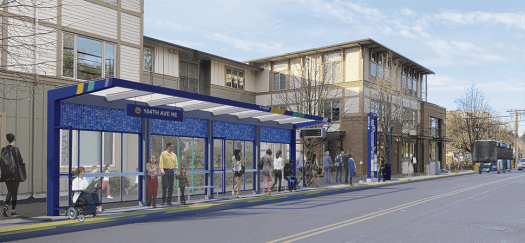
Rendering of the future Stride station at 104th Ave NE in Bothell (image: Sound Transit)

Sound Transit has kicked off a new online open house for its future BRT service along SR 522 and NE 145th street, known as the Stride S3 line. The service, which was funded by the 2016 Sound Transit 3 ballot measure, will run from Bothell to the Seattle-Shoreline border along SR 522 and NE 145th street. From here, riders will be able to transfer to Link Light Rail for fast and frequent service to UW and downtown Seattle, and this service will replace Sound Transit Express route 522 when it opens.

Continue reading “Sound Transit wants your feedback on the Stride S3 line” | 46 comments

News roundup: not nearly enough

Intercity Transit Route 13 at the WA ST Legislature Bus Stop

This is an open thread.

54 comments

Bill would increase housing supply, needs your help

Washington State Capitol Legislative Building.jpg
CC BY-SA 3.0, Link

[UPDATE: Sources say HB1157 will be ruled “necessary to implement the budget,” which gives it some more time to live. But it still needs your help!]

Two companion bills, HB 1157 and SB 5390, would create incentives for local government to allow more housing, but at least one of them must emerge from its committee Monday (Finance and Ways and Means, respectively) to succeed in this session.

Both versions of the bill have a bipartisan group of sponsors. In the Senate, it’s Liias (D-Edmonds), Gildon (R-Puyallup), Nguyen (D-West Seattle), and Saldana (D-Rainier Valley). In the House, there are 18 sponsors from urban, suburban, and exurban districts, including Fitzgibbon, Harris-Talley, Hackney, Walen, and Ryu from Seattle and its inner suburbs. Thank your district’s delegation for its sponsorship!

The bill would allow cities or counties to create “real estate excise tax density incentive zones” where they get a portion of the REET proceeds. To qualify, the zone must allow “Single-family detached dwellings at a net density of at least six dwelling units per acre [1], duplexes, triplexes, fourplexes, townhomes, accessory dwelling units, and courtyard apartments.” To qualify, cities and counties cannot allow the units to be short-term rentals for more than 30 days per year.

Continue reading “Bill would increase housing supply, needs your help” | 43 comments

Denny Way & 3rd Ave bus improvements…finally

Denny Way at 3rd Ave (Google Maps)

From the SDOT blog:

The 3rd Ave and Denny Way Signal Improvements Project will be modifying signals, updating existing trolley poles, and reconstruct the triangular block of 3rd Ave, Broad St, and Denny Way to improve transit operation and reliability in this part of downtown.

Thus the beginning of the end for one of the longer-running minor subplots here on STB. Thanks to Move Seattle levy funds, Belltown-Queen Anne buses will get their own signal and have a more direct, reliable path across Denny Way.

You can read our exhaustive coverage going back nearly nine years: 2012, 2013, (2013 again), 2014.

14 comments