
On transit priority to Expedia

Photo by Martin H. Duke

Danny Westneat, in a very good Seattle Times column last week, tears into the hypocrisy of parking being built at downtown and SLU corporate campuses, particularly Expedia:

This two-step between quietly nodding to our car-focused reality while espousing the greenest dreams perfectly captures what passes for transportation planning in the Emerald City.

We wish you wouldn’t drive, the government announces. But we know you’re gonna, the private market whispers in echo.

In fact the market is so certain you’ll drive that it’s building more space for your cars at this new high-tech campus than will fit in the garage at the Mariners’ stadium.

1000% agree. Developers are building a ton of new garages but no new road capacity. It’s worse than pointless. Seattle does have regulations that attempt to curb the amount of parking constructed in high-transit neighborhoods, but they’re not aggressive enough.

Later in the column, though, Westneat laments the lack of transit options to Expedia:

My view is that Seattle desperately needs more mass transit faster, to give better alternatives to all this driving. I’m a longtime fan of forcing this change sooner by turning some car lanes over to true mass transit, such as buses or light rail (not piddly stuff like the streetcar).

Yes, it’s true the train to Expedia is 16 years away. But it’s important to note that Expedia does have a very frequent bus: the D line. There’s also the 19/24/33 on Elliott. Unfortunately, both corridors have only intermittent transit priority. The D Line needs exclusive lanes through Uptown, and/or an Express variant, and the others need full-time bi-directional bus lanes all the way from Interbay to Denny Way.

The column prompted me to reach out to SDOT, where I learned that D Line and Elliott Avenue improvements are being studied this year as part of the ST3-funded “quick wins” (remember those? Still coming!) for Ballard and West Seattle. When Expedia first announced their move in 2015, SDOT also told us that they would consider off-peak bus priority on Elliott. As far as I can tell from Google Street View, nothing has changed since 2015: it’s still peak-only BAT lanes that end well short of Denny. If we want to make a dent in driving, we have to do more, and it’s disappointing that so little progress has been made in the four years since the Expedia announcement.

(In fairness, I’ll take a mulligan on this one as well: when I listed places to add bus lanes last fall, Elliott didn’t make the cut. I mistakenly assumed it was already a done deal.)

If SDOT does come back next year with a proposal for improving bus service on Elliott and in Uptown, there will no doubt be opposition from local businesses in those corridors. When that happens, it will be helpful to have Seattle Times opinion columnists, and not just us lowly bloggers, pushing back.

108 comments
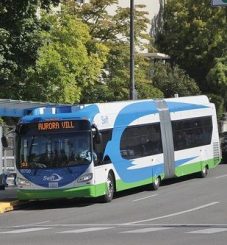
Snohomish County agencies roll out low-income fare today; Everett Transit regular fare goes up again

Community Transit and Everett Transit are rolling out new low-income fares today, expanding the reach of the ORCA LIFT program that debuted in 2015, and expanded upon Kitsap Transit’s low-income fare program in place since 1985.

Meanwhile, Everett Transit regular fares climb to $2 (and remain $2.50 on route 70).

photos by Bruce Engelhardt

If your household income is 200% or less of the federal poverty level, you qualify for this low-income discount program. Both Snohomish County transit agencies are partnering with the Department of Social and Health Services at various locations to do the qualification process (which also started today). You may qualify for and get access to additional benefits while there. There are also lots of locations around King County that process qualification.

The ORCA LIFT card is free the first time for those who qualify, and then $3 for a replacement. Youth ORCA cards (for riders 6-18 years old) are usually $3, but the fee is waived if you get a youth card for someone in your household while getting the ORCA LIFT card.

The ORCA LIFT discount is good for two years before you have to requalify. The expiration date will be stamped on the card. After that, the card reverts to being a regular ORCA card.

Once you qualify, obtain your card, and load cash value or a monthly pass onto the card, your card account will be charged the following amounts when using the ORCA LIFT card.

  • $1.50 on Everett Transit, except route 70 (new)
  • $1.25 on Everett Transit route 70 (new)
  • $1.25 on Community Transit local routes (new)
  • $2.00 on Community Transit commuter routes (new)
  • $1.50 on ST Express buses
  • $2.50-$4.25 on Sounder
  • $1.50 on King County Metro
  • $1.50 on Link Light Rail
  • $1.50 on Seattle Streetcars
  • $3.75 on the West Seattle Water Taxi
  • $4.50 on the Vashon Island Water Taxi
  • $5.00 on eastbound Kitsap Transit foot ferries from Seattle to Bremerton and Kingston
  • $1.00 on westbound Kitsap Transit foot ferries
  • $1.00 on intra-county Kitsap Transit foot ferries
  • $1.00 on Kitsap Transit buses

Monthly passes cost $9 per 25 cents of single-ride fare. So, for example, a $54 monthly pass covers the first $1.50 in fare for each ride. For services charging a higher fare than what is covered by your monthly pass, only the difference between the higher fare and the fare the pass covers will be charged. ORCA transfers are good for 2 hours, among all ORCA agencies except Washington State Ferries.

However, you have to use loaded ORCA product on the card in order to get the ORCA LIFT discount.

Pierce Transit and Washington State Ferries are the remaining members of the ORCA pod that do not have a low-income fare. Pierce Transit charges $2 regular fare, which is also what gets charged to ORCA LIFT cards. Washington State Ferries not only charges much more for any of their services in one direction (and free in the other), but also does not accept inter-agency transfers or passes.

See the table at this previous post for the current fares for all payer categories throughout the ORCA pod, except for Washington State Ferries.

0 comments

dxʷləšucid signs

Some time ago I contemplated whether our buses—wherever they are on Coast Salish lands—would bear place names in dxʷləšucid (Lushootseed), the language of indigenous Coast Salish peoples from Nisqually all the way to Skagit. It was early winter of 2018 when I began packing for my trip to the Samoa archipelago. Something caught the corner of my eye outside the faculty offices of the UW Anthropology department: the Burke Waterlines Map. I perused the map, pinned to the bulletin board unfolded, and, curious as to where the Lushootseed place names belonged on the map, began to piece together village by village, water site to water site, into my head already deeply colonized by the more familiar English place names I was taught to know, love and sometimes hate.

What if public transportation can bear these place names?

Continue reading “dxʷləšucid signs” | 30 comments

The Downtown Seattle Association wants to re-imagine Third Avenue

In 2009 the City of Seattle commissioned a study that called Third Avenue “uninviting, unattractive and generally a dreadful place to walk, shop or wait for a bus.”  In 2014 Metro commissioned a design study on ways to fix the street.  That led to the Third Avenue Transit Improvements Project, and will eventually result in a much-needed transit-only signal at Third and Denny.  

Yet, after all these studies, few would consider the street to be substantially transformed.  

Over the same timeframe, more buses have been added.  In 2010 2011, Routes 15 and 18 (now RapidRide C/D), along with all the West Seattle routes, were moved from First to Third to accommodate Viaduct construction.  Then in 2016 the Seattle TBD added funding for more service on all bus routes, including many on Third. Finally, earlier this year the bus tunnel closed and a whole bunch of buses moved upstairs.

There are advantages to this consolidation.  Buses can be given priority right-of-way, off-board payment systems can be installed and transfers can be streamlined in much the same way that certain hub airports get bigger and bigger over time: more destinations lure more riders, which in turn justify more destinations.

But there are downsides as well: the street can become unpleasant, overcrowded, and choked with diesel fumes. And if Third is perceived as a bad place for business, merchants on other streets will fight against a busway on their street, leaving Third even more crowded. 

According to the Downtown Seattle Association, the latest group to try and “fix” Third Avenue, the sheer number of buses and lack of sidewalk space creates an uninviting environment. Their recently-released vision plan for the street imagines wider sidewalks, a much-improved pedestrian experience, and a more efficient deployment of buses through the corridor.  

Continue reading “The Downtown Seattle Association wants to re-imagine Third Avenue” | 70 comments

News roundup: it’s just talk

King County Metro
Busologist/Flickr

This is an open thread.

60 comments

Next train signs are finally here

After years of protests that it couldn’t be done, and six years of study and work, Sound Transit has finally found a way to put next train arrival times on the existing message boards at stations that opened in 2009. Capitol Hill and UW Station opened with this capability in 2016. Between Angle Lake and Westlake, arrival times rapidly rotate with other messages. Riders need wait no more than a few seconds to get the key info.

The picture above is on the mezzanine level. There is a similar sign on the tunnel entrance, a good indicator on whether or not to hustle. At the platform level, the signs only display the relevant direction (see below).

Continue reading “Next train signs are finally here” | 58 comments

Seattle Subway: It’s time to start work on ST4

#ST4Seattle Map by Oran

People love riding Link. The more Sound Transit builds, the more Seattle votes with our feet. But planning and building expansions can take decades. It’s clear that we need Link expansion beyond what is currently planned, and our rapidly growing city and the burgeoning climate crisis demand we take action without delay. That’s why it’s time for Seattle to start working on ST4, the next round of Link rail expansion.

Looking ahead to the completion of ST3’s Seattle expansions in 2035, we see a city that has made huge strides building high quality transit but still lacks a comprehensive subway system. It’s a system that will still have frustrating gaps, lacking stations in our densest residential neighborhoods like Belltown and First Hill.  We must think bigger and bring service to the entire city. A true Seattle Subway means being able to catch a train in Georgetown, Wallingford, or White Center and take a ride to Lake City, Crown Hill, or Fremont. ST3 is a huge step forward, but it falls well short of the vision of ST Complete, the vision of a Seattle fully connected by high-quality transit. 

Seattle can’t afford to wait; it is imperative that we take charge of our future. Seattle is adding more residents than all King County suburbs combined. Our next expansion vote should come in 2024, on the heels of the opening of major expansions to Northgate, Bellevue, Redmond, Federal Way, and Lynnwood. More people than ever will be riding Link. More people than ever will be asking: Why can’t we have Link in our neighborhood? We must be ready with the best possible answer: You can.

Continue reading “Seattle Subway: It’s time to start work on ST4” | 179 comments

Seattle District 2 candidate ratings

District 2 has seven candidates for an open seat on the Seattle City Council. While none of them are uniformly outstanding on transit and land use issues, some are much better than others. As a reminder, here’s our rating system.

Excellent

The two candidates in this tier share a lot of common ground. They are both for safer streets, more housing types in single family zones, and prioritizing transit. In both cases, concern about displacement veers into unproductively demonizing developers. We would not characterize them as transit wonks, and there are occasional positions we don’t like in their policy mix. But we believe the impact of either overall would be strongly positive.

Continue reading “Seattle District 2 candidate ratings” | 19 comments

Sunday Open Thread: District 4 MASS Forum

The Moving All Seattle Sustainably Coalition held a candidate forum for the Seattle City Council’s 4th District on May 30, 2019. Rooted in Rights made the video, and provided a transcript.

Candidates attending included, from left to right:

We posted the videos and discussed the races for Districts 2 and 3 previously.

This is an open thread.

13 comments