
Pronto vs Biketown: The Northwest Bike Share Showdown

bike-wars

I recently had the opportunity to check out Portland’s new-launched bike share system, Biketown. While the bikes are similar, the rest of the system is quite different and there are many things Seattle could learn while mulling Pronto’s expansion. I joined Pronto earlier this year and use it several times a week. The two systems are similar but have one very distinct and important difference.

Biketown is operated by Social Bicycles, who operate bikes share systems in 25 other cities in 3 countries. Unlike Pronto’s system operated by Motivate, Biketown does not require users to return bikes to specific stations. At the end of the trip, riders can simply lock up the bike to any public bicycle rack, albeit for a $2 fee. Rescuing a bike from a non-Biketown rack will net the next rider a $1 credit. Riders locking bikes up to racks outside the home area are hit with a $20 fee. By not forcing riders to start and end their trips at specific stations this effectively solves the full or “dead” docks that Pronto users experience. It also enables an additional layer of convenience.I recently had the opportunity to check out Portland’s new-launched bike share system, Biketown. While the bikes are similar, the rest of the system is quite different and there are many things Seattle could learn while mulling Pronto’s expansion. I joined Pronto earlier this year and use it several times a week. The two systems are similar but have one very distinct and important difference.

Pricing

Pronto Biketown
Single ride N/A $2.50
24 hours $8 $12
3 days $16 N/A
Annual $95.40* $144

*$85 if paid up front.
Pronto’s prices do not include sales tax.

All Biketown plans include a set number of minutes per day with overage at 10¢ per minute. Pronto’s prices are capped per-trip (45 minutes for annual members, 30 minutes all others) with overage at $2.00 for the first 30 minutes and $5 for each additional 30 minutes. Each Pronto trip comes with unlimited trips, so you could theoretically keep a bike for 24 hours straight for just $8 if you made sure to visit a dock every 30 minutes.

Signups

Biketown has a mobile app and riders can sign up for any plan through the app. I attempted to do this but the Android app simply displayed an empty screen so I was unable to complete registration through the app and had to do so through the mobile-friendly website. Riders can also purchase any plan at stations that have a kiosk (about half of them). Pronto sells 24-Hour and 3-Day Passes only at stations. Annual passes are only sold online. Pronto does not have a mobile app, but directs to third-party apps that show bike/dock status.

Stations

I won’t pretend to be an expert on Portland’s geography, but with a semi free-floating system the station siting is less important. With Pronto, I often find that bikes are a few blocks away from my origin or destination. Pronto’s station footprint is large enough that it is useful for many short trips in and near Downtown but small enough to not be useful for a majority of Seattle.

Bikes

Both systems use bikes with a step through frame (AKA “girl” bikes). This makes it for riders of all heights easy to start the right way. Both bikes are built with internal hubs. Most bike riders will be familiar with the more popular derailleur design for shifting gears where a chain slides on to differently sized sprockets. In stark contrast internal hubs allow the bike to be shifted while stopped and generally can’t be shifted while pedaling. Shifting is accomplished by twisting a grip on the handlebar near the rider’s thumb. Pronto’s bikes use a 7 speed hub connected to a chain (with a chain guard) whereas Biketown uses an 8 speed hub with a shaft drive. I sometimes experience issues with slipping gears on Pronto, but this wasn’t (yet) an issue on Biketown’s two month old bikes.

I’d need to see the spec sheets or ride both bikes on the same terrain to be certain, but my anecdotal observations were than the first 7 gears had nearly the same ratios. This means that Biketown’s eighth gear is meant for higher speeds on nearly flat terrain. I’d prefer to trade this for a lower gear at the opposite end.

Both feature a front basket. The Biketown basket is larger and fully enclosed and is great for hauling small items whereas the Pronto basket is U shaped with a bungee cord and better for hauling larger items (such as a yoga mat). Both have built-in front and rear lights that turn on automatically. The handlebars on the Biketown bikes feel very narrow; I imagine that those with broad shoulders will be riding with their elbows pressed in to their sides. I found the rubber grips on Biketown’s brake levers to be a nice touch.

Helmets

Unlike King County’s all-ages helmet law, Oregon’s law stipulates that riders 16 and over are not required to wear a helmet. Thus, Biketown encourages the use of but does not offer helmet rentals. Pronto charges $2 for helmet rental except for annual members for which it is free. Helmets are available at every station.

Rental Experience

With Biketown, all interaction takes place on the bike’s built in computer which sits over the rear wheel. Riders can start a trip by entering their 6 digit account number followed by a 4 digit rider-assigned PIN.

With Pronto, 24 hour and 3 day pass holders need to swipe their credit card at the station’s kiosk and then enter a four digit bicycle number to check out a bike. Strangely, this option is not available for annual members, necessitating the use of a Pronto-provided keyfob in order to check out a bike. Non-annual members can purchase a keyfob for $2.50 and enjoy similar convenience.

Biketown also provides a RFID card for annual members and sells them to non-annual members. Checking out a bike still requires entering a PIN, essentially trading the convenience of not having to memorize and type a 6 digit number for yet another card in the rider’s wallet. The account number can also be viewed through the mobile app.

Starting a Pronto trip with a Pronto keyfob usually takes under 5 seconds. Biketown’s on-board computers are laggy and it takes approximately one second to enter each number. Additionally, the displays have poor contrast and I found it to be difficult to read even in the shade. Docking is similar; Pronto trips end nearly instantaneously after rolling the bike in to the dock, whereas Biketown requires sliding the U lock in to place before the trip completes (but requires no other user interaction).

Having a built-in lock is a huge benefit for Biketown. Any trip that requires a stop between stations is easy—riders can simply lock the bike up with the lock they undid to begin the trip. With Pronto, a similar feat would require riders to bring their own lock with them or ensure all their destinations are near Pronto stations. Coupled with Pronto’s small footprint, this has made some trips so inconvenient to the point where I consider them impossible.

After a trip, Pronto members can log in to an online portal to see their rental history which shows the start and end stations as well as start/end times and duration down to the second. The Biketown app and website show all that plus a GPS trail of the trip.

Despite only using the system for a day, I see tremendous advantages in a semi free-floating system compared to Pronto’s forced station-to-station system. While I would definitely welcome the addition of electric pedal assist, I feel that a more successful system could be realized by placing bikes in places where people can access them.

Photos:
Biketown bikes photo by the author.
Pronto at Capitol Hill Station by SounderBruce CC BY-SA on Flickr
27 comments

The UDistrict Rezone Needs Your Support

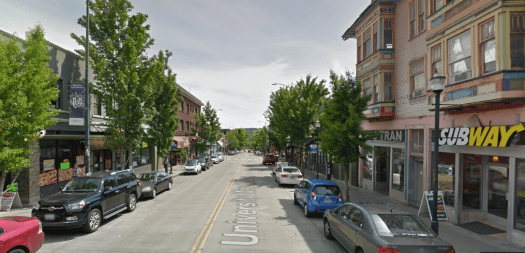
The Ave in 2014 (Google Maps)

[Update 12:41pm. I neglected to mention any specific advocacy opportunities, but your first opportunity to have an impact is to attend the Planning, Land Use, and Zoning (PLUZ) Committee hearing on Tuesday, September 20th at 9:30am in Council Chambers. Supportive public comment would be most welcome.]

[Update x2 2:58pm. Corrected numbers for Seattle’s population and housing growth rates.]

Yesterday Mayor Murray held a press conference to announce the penultimate move in the big UDistrict Rezone. After half a decade and nearly 100 meetings, it’s finally time to send it to the City Council. And make no mistake, this is the big one.

To date, Link-related zoning changes within Seattle have been meager and disappointing, while many suburban jurisdictions have done relatively better. Lynnwood has created a Center City zone around its future Link station, with heights up to 125′ permitted. And in Kent near Highline College, the height limit is 200′ and there are minimum densities required by code.

By contrast, the most-lauded rezones, at Capitol Hill, Roosevelt, Mount Baker, and Othello, still cap development at 85′. Other residential Link stations are still waiting for their first big rezone, with single-family or lowrise zoning still predominating around Beacon Hill, Columbia City, and Rainier Beach. And of course there are several stations with industrial or institutional uses that inhibit either commercial or residential growth, at Sodo, Stadium, UW, and to a lesser extent Northgate.

2023-link-zoning-chart-01-01
Chart by the author

So the UDistrict Station rezone is a big deal; it’s our only crack at creating another true urban center, or even a second downtown. If the Council approves, we will create 5,000 new housing units and build the dense high-rise neighborhood that the state’s largest major institution deserves. An entire generation will be able to live in or near the UDistrict, instead of making the commute from Snohomish or South King Counties. It needs to happen, and it will need your support.

The proposal seeks a core density of 320′ buildings immediately around the station, stepping down progressively into 240′, 85′, and 75′ zones, all mixed use. The broader urban design includes provisions for protected bike lanes, green space, community-oriented commercial uses such as daycare, and more. It largely eschews the misguided windswept plazas that had earlier momentum, and most of the aggressive height increases have made it through the 5-year process relatively unscathed. Let’s help take it across the finish line.

The Council appears to be softly supportive at this time, but potential amendments (particularly by Herbold and O’Brien) have the potential to jam the gears a bit. In a joint press release, Herbold and O’Brien announced their intent to encumber developers with requirements beyond the newly-enacted Mandatory Housing Affordability (MHA) regulations,

Because this upzone increases zoning capacity beyond what was anticipated in the MHA-R bill, we look forward to working together to ensure increased affordability requirements for the neighborhood. From the MHA-R legislation: ‘The Council intends to consider whether to include higher [affordability] performance and payment amounts … (b) [in] areas where the increment of increased development capacity is greater than the standard MHA-implementing zone change; and (c) … to increase affordable units sufficient to offset the affordable units at risk of demolition as a result of the increase in development capacity due to MHA. (emphasis mine)

We’ll have to see the numbers, but it would be ironic and unfortunate for the Council to seek even higher developer fees because they fear the production of too much housing. The Mayor’s own release estimated that MHA in conjunction with the rezone would produce 620-910 affordable units, more than offsetting the older affordable units at risk of demolition whether the rezone passes or not. So the appropriate question is not if those units will be replaced, but what will replace them. In that context, more units means less competitive pressure on housing prices.

Seattle is gaining 15,000 new people per year, and we’re only building housing for 12,000 of them, so population growth is outpacing construction by 25%. Even if it were true that stopping upzones would keep newcomers from coming in the first place, you would be actively advocating for a local recession, urban decay, and the impoverishment of your friends and neighbors. But in all likelihood slowing housing production only means that the newcomers will outbid those of us already here with the only leverage they have: their wallets. Let’s give them lots of places to live, shall we?

85 comments

Reminder: Service Change Started Saturday

Happy first weekday of the service change everyone. Let us know in the comments if you’re riding any changed routes and how it’s going for you.

As a reminder, here’s what’s new either over the past weekend or today:

  • Link is in full simulated service for Angle Lake. Set to open in just 12 days, all trains are now running out of service to Angle Lake. This means that all SeaTac/Airport passengers will now deboard from the southbound platform, and all Seattle-bound passengers will board from the northbound platform. No more tourist confusion about which train to board.
  • Mid-Day Sounder is live. A cute 2-car train left Lakewood this morning at 10:18am with just 10 people aboard. The train picked up another 7 in South Tacoma, and another 20 in Tacoma, where I left the train. These loads are roughly what you’d expect on a standard reverse-peak trip. Though the train will surely get more popular as time passes and awareness builds, the new 2:30pm return trip will likely always be much busier than the late-morning trip.

    img_2841
    Inaugural mid-day (10:18am) trip from Lakewood.
  • Route 106 is live on MLK, Rainier, and Jackson. The Downtown Seattle Transit Tunnel is now slightly less congested (2 fewer buses per hour), MLK maintains roughly the same frequency, and Rainier now has 10 buses per hour instead of 6 (though they will always be unevenly staggered due to mixing a 15-minute and 10-minute route). And happily, Skyway residents now have frequent service. It will interesting to follow to see if the new MLK-Little Saigon connection is successful in attracting ridership compared to a (faster AND cheaper) Link ride.img_2846
  • Route 107 now serves Georgetown and Beacon Hill. Route 107 has been extended from Rainier Beach to Beacon Hill via a (likely not so quick) out-and-back to Georgetown. The real benefit to this corridor is that 15th Avenue S now has 66% more service, with 5 buses per hour instead of 3 between Georgetown and Beacon Hill Station. That’s a huge win for Cleveland High students, VA riders, and others.
  • Route 124 is now frequent all-day. Thanks to a somewhat controversial but ultimately successful use of  Prop 1 funds, Route 124 is now frequent all-day. Though Georgetown doesn’t see any additional service (as Routes 124 and Routes 106 formerly combined for an approximation of frequent service), the new service pattern is much more legible. Southbound riders headed for Georgetown no longer need to choose between 3rd Avenue and the Downtown Seattle Transit Tunnel, and having a single route allows even headway spacing. And not to mention the doubling of service for those along East Marginal Way, International Boulevard, and Tukwila.  

Lots of other minor changes were made also, including a needed boost to weekend frequency on routes serving ULink. Check out Metro’s service change page, Sound Transit’s, or our previous overview.

26 comments

League of Women Voters Hosting ST3 Forums

Snohomish Co. Executive John Lovick at ST3 Open House

The League of Women Voters is hosting a series of free public forums on Sound Transit 3 at five locations around the region. Each forum will feature pro and con speakers, including Sound Transit CEO Peter Rogoff, Transportation Choices Coalition’s Shefali Ranganathan, and Smarter Transit’s Maggie Fimia.

  • Tacoma – Monday, Sept. 12 at 7 pm (tonight): Phillips Hall, UW Tacoma Campus, 1918 Pacific Ave. (use Tacoma Link)
  • Bellevue – Tuesday, Sept. 13 at 6:30 pm: St. Andrew’s Lutheran Church Fellowship Hall, 2650 148th Ave. SE (use Metro routes 221, 226, 245, and 271 from Eastgate P&R)
  • Auburn – Saturday, Sept. 17 at 10 am: All Saints’ Lutheran Church, 27225 Military Road S (use Metro route 183 or ST Express route 574)
  • Lynnwood – Monday, Sept. 19 at 7 pm: Lynnwood Library, 19200 44th Ave. W (use CT route 112)
  • Seattle – Tuesday, Sept. 20 at 7 pm: Seattle First Baptist Church, 1111 Harvard Ave. (use Metro route 2)
5 comments

ST3 Campaign Kickoffs In Everett, Seattle, Bellevue & Tacoma This Week

mtn-kickoff-header

Mass Transit Now, the campaign to pass Regional Proposition 1, also known as Sound Transit 3, which this blog has wholeheartedly endorsed, is holding a series of campaign kickoff events around the region this week.

Everett: Monday, September 12 (tonight!) 5-7 pm, The Anchor Pub, 1001 Hewitt Ave.
The Anchor Pub is at the west end of Hewitt Ave, and in short walking distance of many Everett Transit buses, as well as Swift. Only three ET routes (2, 12, 70) don’t serve Everett Station, and those three also go nowhere near the Anchor Pub.

Seattle: Tuesday, September 13, 6-8 pm, Neumos, 925 E Pike St.
Neomos is four blocks south of Capitol Hill Station, at the southwest corner of Pike and 10th Ave.

Bellevue: Wednesday, September 14, 5:30-7:30 pm, Lunch Box Laboratories, 989 112th Ave. NE
Lunch Box Laboratories is four blocks north and a block and a half east of Bellevue Transit Center, on the south side of NE 10th St.

Tacoma: Thursday, September 18, 6-8 pm, 7 Seas Brewing, 2101 Jefferson Ave.
7 Seas is on the east side of Jefferson, halfway between S 21st and 23rd St, four blocks west and uphill from Pacific Ave (where the streetcar and most buses run), and a couple blocks south of UW Tacoma. Half-hourly Pierce Transit route 48 serves the nearest bus stops on Jefferson, connecting to other bus routes north of 17th on Pacific Ave.

6 comments

Pierce Transit Restoring Midday and Night Service

PT 224 on Pacific Avenue

Beginning tomorrow, September 11, Pierce Transit will improve midday frequency and expand weeknight service on 13 of its routes. This is the second major expansion of the system since the Great Recession, during which the agency cut much of its service, withdrew from several cities, and failed to pass two ballot measures. Pierce Transit joins Metro, Sound Transit and Community Transit in adding service this weekend, during a coordinated region-wide schedule change.

The system’s busiest corridor, route 1 on Pacific Avenue and 6th Avenue, will see midday frequency restored to 15 minutes. Route 2, serving Lakewood and University Place, will see midday frequency boosted to 20 minutes. Route 51 will be revised to terminate in the Springbrook area of Lakewood instead of the Lakewood Sounder station. Other routes are receiving additional trips to extend service later on weeknights.

A full list of changes is available after the jump.

Continue reading “Pierce Transit Restoring Midday and Night Service”

| 43 comments

Study: Car2Go Reduces Vehicle Ownership, Driving

Car2Go and Metro Rt 67 on Campus Parkway

The idea that carsharing membership would reduce vehicle ownership is intuitive.  However, the overall impact on Vehicle Miles Traveled (VMT) is less obvious. While an explicit per-mile charge discourages marginal driving, carsharing can also avoid an inconvenient transit trip for travelers who would not have purchased a car, or would have been deterred by the expense of parking.

A new study by UC Berkeley’s Transportation Sustainability Research Center (TSRC) is based on Car2Go vehicle data and a customer survey. It examines these tradeoffs in five cities, in increasing order of density: San Diego, Calgary, Seattle, Washington, and Vancouver. Seattle’s results are broadly in line with the other four. The core finding is that most Car2Go users keep their cars,  and Car2Go use simply increases their driving. However, a minority sells a car (or neglects to purchase one) due to their membership, and their effect is large enough to make Car2Go’s impact a net reduction in Vehicle Miles Traveled (VMT) and Greenhouse gas emissions.

A study that determines why people are selling cars inevitably introduces the imprecision of survey data, but the finding holds up against very conservative assumptions about how much those unbought cars would have traveled. Car2Go provided trip data, and survey access to its customers. The study’s funding came from several different governments and Car2Go itself.

The study estimates that each Car2Go in the Seattle fleet leads to the sale of 3 private cars, suppression of 7 would-be car purchases, and a net reduction of between 19,000 and 59,000 miles of driving annually. (The high uncertainty is due to the difficulty of figuring the amount that a car not purchased would be driven). That comes out to between 6 and 14 metric tons of greenhouse gases per vehicle. Cumulatively, that’s between 12m and 34m miles of driving eliminated from Seattle in one year. Continue reading “Study: Car2Go Reduces Vehicle Ownership, Driving”

| 62 comments

County Budget to Boost Metro Service and Security

Route 106 at Rainier Beach Station. Photo by Oran Viriyincy.

Yesterday County Executive Dow Constantine launched the official Long Range Plan process, moving it from a (very good) draft to an actionable item of legislation. Now called “Metro Connects“, the County Council will tinker with and debate it through the autumn, with expected adoption in early 2017. As a reminder, the plan would a number of good things: commit Metro to a full alphabet of Rapid Ride routes, double ridership by 2040, comprehensively restructure Metro’s system to feed a Sound Transit 3 buildout, move toward a cashless system, and enact a de facto ban on new transit parking with Seattle and other inner-suburb activity centers.

Though yesterday’s launch was a process milestone, the plan’s formal release doesn’t add much to what we already know. But more newsworthy, Dow also took the opportunity to preview the next biennial budget, and it contains a number of substantive improvements independent of Metro Connects.

Boosted by a continued strong economy and solid wage growth in King County, Metro will be in expansion mode:

  • Dow’s budget proposes $30 million in new service hours, including overcrowding relief on 27 routes, reliability improvements to 60 routes, and frequency boosts on a further 18 routes.
  • Metro’s capital program is back, with a 6-year capital spending plan.
  • There will be $215m set aside for bus base capacity, including a new South King County Metro base.
  • Responding to legitimate concerns over operator safety and comfort, the plan will put cameras on 100% of Metro’s fleet ($8m) and expand Metro’s operator comfort stations ($7m)

We’ll have to wait until late September to see the list of routes proposed for improvements. Though the non-supplantation clause in Seattle’s Prop 1 agreement should ensure that Seattle gets its full proportional share of improvements, we’ll be there to analyze it along the way. And as the Metro Connects process moves through council, it will be interesting to see the degree to which council meddling alters the plan. So stay tuned and engaged throughout the fall, but things are generally looking up for Metro.

35 comments