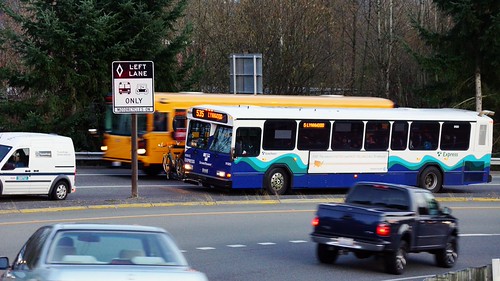
Back in 2012 I wrote a skeptical piece about the prospects for Pronto (née Puget Sound Bike Share) in Seattle. I saw our dearth of safe bicycle facilities and rare all-ages helmet law, alongside the traditional complaints of hills and weather, as potentially fatal to the confident spontaneity that drives bikeshare ridership. Though some of my fears proved unfounded – Pronto safety hasn’t been an issue – other even greater problems have depressed ridership and revenue and led to an early crisis and possible demise. Absent a city buyout, Pronto risks shutting down on March 31.
The Sustainability and Transportation Committee will vote tomorrow (Tuesday, 3/1)on whether to proceed with a $1.4m buyout of the system. The proposal before the Council would purchase Pronto’s privately-held capital assets, namely the remaining 26 stations it doesn’t already own, maintenance and fleet rebalancing equipment, helmet vending equipment, etc. The City would retain the current contract operator (Motivate) for the remainder of 2016, and then restructure the system for relaunch and significant expansion in 2017. The $1.4m would incur no new costs, but rather incur lost opportunity costs by transferring 28% of the $5m already allocated in the City’s budget for bikeshare expansion. Failing to purchase the system would also trigger repayment of a $1.0m FTA grant, so the net outlay here is $400,000, or roughly what King County Metro spends every 2.5 hours.
If you believe, as I do, that Pronto’s problems lie in its execution rather than any systemic inability for Seattle to embrace bikeshare, then saving it is an essential first step toward building the successful system we know is possible. If you believe in Pronto’s ultimate success, shutting the system down only to inevitably relaunch at a later date at much greater cost would be incredibly foolish. If you agree, please let your committee members (O’Brien, Johnson, Sawant, and Herbold) hear from you today.
For our next podcast, which will air sometime next week, Frank and I plan to select some questions from readers. So if there’s any subject you’d like us to discuss or questions you’d like us to answer, put it in the comments below before Sunday evening and we’ll consider if we have anything remotely interesting to say about it.
Land costs are also part of why yearning for the old days of moderate-cost bungalows is unproductive. A century ago, in most cities, it was possible to find relatively cheap land within commuting distance of downtown—partly because the invention of streetcars had just radically expanded the definition of “commuting distance”—so if you could build a house cheaply, you might end up with a relatively low-cost home. But as cities grow, and especially as their metropolitan economies grow, there’s more and more people competing for a fixed amount of land within easy commuting distance of job centers. As a result, the price of easily accessible locations—that is, land—increases substantially. At that point, it doesn’t really matter so much if you can build a home very cheaply, because the cost of the land it sits on will ensure that the total price of construction will be very high.
We’ve made very little progress in the last 100 years in reducing commute times. Every time we get a new transportation technology (i.e. cars) we burn up the time savings building more sprawl. Long live Marchetti’s Constant. But now that we’ve hit the limits of sprawl, we’re just spending more time in traffic.
It’s becoming cliche to note that 65% of Seattle’s land is off limits to development (zoned for single-family homes and parks). Some percentage of the remaining 35% is presumably already developed to the zoning limit. That means all the city’s growth has to happen in the small fraction that remains. Intensive development + small amount of buildable land = high land prices. Some may lament that new housing is only built for the top end of the market, but when land prices are high and height limits are low, expensive houses are really all that can be built. And yet the developer, not the landowner, receives the bulk of the public’s ire.
Municipalities try to ameliorate the expensive housing with subsidies, but the cost of land eats through scarce government funds. San Francisco, for example, is planning to spend almost $900,000 per apartment to build affordable housing in the Mission because of high land costs.
The simplest answer is to build more densely where the land is cheaper, i.e. in single-family neighborhoods. Instead, current city policy encourages people to tear down single family homes and replace them with even larger, more expensive single family homes, which seems like the opposite of making things more affordable. The “charming” old bungalows are going away one way or another, the only question is what they get replaced with.
During institutional comment on Sound Transit 3, Seattle strongly asked for “early wins” that would show near-term value for Sound Transit 3. The intent of the request seems to be twofold: to chip away at today’s myriad transportation needs and also to incentivize additional ‘yes’ votes on the eventual ballot measure. Yesterday at the Sound Transit Board, Planning, Environment, and Project Development (PEPD) Director Ric Ilgenfritz and PEPD Development Manager Karen Kitsis briefed boardmembers on the types of projects Sound Transit would be willing and/or able to expedite. Staff cautioned the Board that given the likely length of the package, early spending disproportionately reduces later spending due to inflation, so care must be taken to strike a balance between showing quick value to the public and delivering the full investment promised at the ballot. So what could be on the table?
“Pre-rail” improvements. Those within the advocacy community worried about ST3 funds being shortsightedly used for new bus operations can likely breathe easy, as staff stressed that any projects must fit within Sound Transit’s statutory mission of delivering high capacity transit. So while we won’t see Sound Transit making Prop 1-style frequency additions to Metro for RapidRide C and D, Sound Transit did indicate a willingness to pay for capital improvements to bus corridors selected for rail. For Ballard and West Seattle, for example, this could include mean an ST3 contribiution towards extending and improving bus lanes in Interbay or on the Waterfront, adding better transit signal priority (TSP) for Rapid Ride, and other rechannelization type efforts.
Infill stations. Staff noted that the infill stations on the Candidate Project list are all within ST2 corridors, enabling their construction prior to any further ST3 Link extensions. Potential locations include Graham Street, Boeing Access Road, N 130th St, and SW 220th St in Lynnwood. Graham and BAR could be finished in just a few years, and 130th and/or 220th could open on Day 1 of Lynnwood Link in 2023. But again, the Board would have to explicitly prioritize them.
Expedited BRT Projects. There are a number of bus-based improvements ST could expedite. SR 522 BRT could be scheduled early to ensure it opens at the same time as 145th Street Station, ST could pay for shoulder-hardening on I-5 and I-405 to allow more transit access, and I-405 BRT could be phased with some early projects.
Access improvements. Staff indicated that many of the small capital projects in the Candidate Project List could be completed early, including new parking garages, bike parking expansions, and Sounder platform extensions.
Technology improvements. This category could include full real-time arrival info at all Central Link stations (currently unfunded), mobile ticketing, NFC payment, and/or expediting the development of ORCA 2.
A photo posted by Kelly Deen Morse (@seattlenewconstruction) on
A few interesting articles on housing and land use caught my eye recently. First up, Nick Fitzpatrick in Forbes:
An Axiometrics study of two metropolitan areas – Dallas and the San Francisco Bay Area — showed that the submarkets with the highest-ranking Walk Score in the market tend to have the highest average rent per unit. Though correlation doesn’t necessarily mean causation, high Walk Scores seem to be in high demand.
Walkable neighborhoods are popular. We should build more of them! Next up, Roger Rudick in Streetsblog, drawing attention to a huge plot of undeveloped land right next to a CalTrain station:
The problem, said Levin, boils down to the fact that the station and the adjacent land is located outside of the San Francisco limits, in the City of Brisbane, population 4,282 as of the 2010 census. Developers would like to add enough mixed-use, transit oriented development to double the population of Brisbane. But Levin said the city council doesn’t want that–and has pushed for office parks and retail that, she said, might provide more tax revenue. “It’s still partially a Proposition 13 mindset” which puts sharp limits on how much residential property taxes can increase.
Residential property taxes in California are so low, nobody wants to build more housing. Instead, the idea is to build more office parks and hope some other municipality coughs up the housing units. It’s NIMBY-ism at the the city level. Finally, closer to home, Dan Bertolet, in his new gig at Sightline, looks at one of my favorite topics, backyard cottages (ADUs):
Myriad regulatory barriers currently litter the law books of Cascadian cities, clogging the ADU pipeline. Vancouver’s success in building more than 26,000 ADUs has been all about undoing those restrictions. Starting in the late 1980s, the city legalized thousands of existing, but illegal, ADUs. Over time, it eliminated the most counterproductive barriers.
I’ve been kinda meh on backyard cottages as a scalable housing solution because of all the regulatory barriers Dan enumerates. But if the HALA plan succeeds in removing those barriers, ADUs could certainly put a dent in our housing shortage.
[Update 11:30am: WSDOT responded that the MyNorthwest link reporting Good2Go identity theft is a 2013 issue that has been resolved. We’ve uploaded WSDOT’s full statement here.]
The headline says “war on cash”, but actually Trimet is rolling out a smart card and will consider mild measures to discourage cash fares way down the line.
In the race to pander to people that object to any genuine escape from congestion, Jay Inslee’s latest entry is more of the same old thinking ($):
He is advocating two projects:
• Adding a lane on I-405 at Highway 520 to Northeast 70th Place in Kirkland, where it would become an exit-only lane. Costs might range from $5 million to $30 million, based on noise reduction and fish-protection needs.
• Strengthening the right shoulder of northbound I-405 in Bothell for use as a general lane beginning at Highway 527 and ending as an exit-only lane onto Interstate 5 at Lynnwood. It would open to traffic only in peak times, and at speeds far below the usual 60 mph freeway limit, as announced previously by tolling director Patty Rubstello. Costs could range from $30 million to $50 million.
The bottleneck on I-405 used to be in Kirkland. The addition of new lanes did what highway expansions always do: it simply moved the bottleneck around, in this case to the 522 interchange. So now Gov. Inslee wants to double down on this with further quasi-widening. The outcome is predictable: the added volume will simply create bottlenecks elsewhere, either on I-5 or on the arterials that feed 405. Adding an exit lane in Kirkland will simply bring the congestion back to Kirkland. Drivers who use the old bottleneck will benefit, and drivers that use the new bottleneck will be worse off. There will be calls for more asphalt, and the cycle repeats.
Not to be outdone, presumptive Republican gubernatorial candidate Bill Bryant “bested” Inslee’s knee-jerk highway widening by proposing to force the buses back in congestion:
Opponents including GOP challenger Bill Bryant are seizing on toll snafus in an effort to weaken the incumbent. Bryant called for “freeing 405’s HOT lane” by converting one of the two special lanes each direction into a general traffic lane, then allowing two-person carpools into the only toll lane for free. That would likely unravel the toll program, as there wouldn’t be much room left for toll payers to join the bus-carpool lane.
After applying the Bryant plan, the I-405 project would ultimately simply add a general-purpose lane and leave buses and vanpools in status quo congestion. As always, we’re only an election away from squashing the region’s halting progress towards good BRT.
Belltown Community Council President Dean McColgan
Belltown’s letter unsurprisingly laments its exclusion from the proposed Ballard line, losing out in favor of South Lake Union. It proposes resurrecting earlier Seattle Subway-style plans for SLU to be served as the starter neighborhood for an SR 99 line, with the Ballard line running through the heart of Belltown instead. Anticipating objections that SLU’s employment density requires it be given priority, the letter argues that Amazon’s new Rufus campus demonstrates that employment is increasingly concentrated in areas traditionally considered Belltown, and that such employment would be equally well served by a 4th Avenue stop as it would one at Westlake/Denny. The letter includes significant documentation of Belltown’s density, employment, and amenities, and criticizes the neighborhood’s exclusion from light rail and streetcar planning. Its desire to be served in ST3 has found traction here on STB as well, with both Frank and Seattle Subway taking up the cause.
Federal Highway Administration
FHWA Washington Division Administrator Dan Mathis
The FHWA limited its comments to areas of common interest between light rail and interstate highways, offering a sentence or two on each candidate project within an interstate catchment area. Their comments are a mixed bag, progressive for a highway agency in some places and traditionalist in others. First, the FHWA seems to favor urban arterials for light rail as opposed to interstates:
Using Interstate right of way as a primary conduit as opposed to an arterial like SR 99 debases the opportunity for appropriate urban densification and its commensurate economic development. (emphasis mine)
FHWA also asks that Sound Transit choose its target market, arguing for either urban arterials with densification, or freeway light rail with more car-centric access provided, but not freeway light rail without parking:
Since the light rail extensions appear to serve car‐based commuters and relies heavy on the existing Interstate, Interchanges, and Park and Ride lots, the ST3 projects may have the potential to increase trips on I‐5 as well as the local system adjacent to those lots and interchanges…We have concerns that placing stations at existing interchanges could significantly increase congestion and decrease safety. ST will need to identify impacts to those interchanges and ensure that the proposed light rail will not prohibit future interchange improvements nor should ST actions result in increased cost to WSDOT to improve those interchanges in the future…If these light rail extension are to serve car based commuters then additional parking needs to be considered. If Sound Transit is assuming to acquire (temporary during construction or permanent) WSDOT parking lots then they could potentially be displacing highway users’ parking at park and ride lots. This will need analysis and may require mitigation.
In what seems like an argument both for transit quality and for minimizing conflict with its highway interests, FHWA believes that ST should take grade separation as a first principle:
A base assumption should be all crossings are grade separated unless there is a compelling reason, regardless of cost. Span lengths should fully span interstate facilities including any future expansion.
Lastly, like many other observers, FHWA also seems puzzled by the lack of connection between South Bellevue and Eastgate under current concepts for light rail between Totem Lake and Issaquah:
This plan leaves a gap in the system along I‐90 between Bellevue Way and Eastgate. That connection should be provided to eliminate the out of direction link through downtown Bellevue and provide a more desirable route to Eastgate.
First Hill Improvement Association, Mercer Corridor Stakeholders, Microsoft, Northwest Seattle Coalition, Queen Anne Community Council, and Transit Access Stakeholders after the jump.Continue reading “Community Feedback on Sound Transit 3”
Might this dock at the Kirkland Marina have a Water Taxi in its future? (Photo by the Author)
On February 8, the King County Council accepted the final report on Water Taxi expansion. The Council vote followed an occasionally contentious review at the TrEE (Transportation, Economy and Environment) Committee the week before. No decision was taken on moving forward with the expansion. That’s a budgetary decision to be taken up, if a request is made, as part of the budget process later this year.
The final report refines analysis presented in the interim report, and accommodates some suggestions by the jurisdictions and stakeholders that might be served. But the key findings haven’t changed greatly. Three routes are being considered:
Kenmore (Log Boom Park) to University of Washington (Waterfront Activity Center)
Kirkland (Marina Park) to University of Washington (Waterfront Activity Center)
Ballard (Shilshole Marina) to Downtown Seattle (Pier 50).
A few modifications are suggested. In Kenmore, the ferry may eventually serve Lake Pointe where development could create an opportunity for shared parking (initial service would be via Log Boom Park with parking at a remote lot served by shuttle bus). In Kirkland, where downtown parking for transit riders would not be available, a circulator shuttle to bring riders to the Marina is examined. Expedia has asked that the ferry from Shilshole Bay stop at Interbay en route to downtown Seattle.
The revisions to the proposal do not improve expected performance. These are low-ridership high-cost services. At launch, off-season ridership would range between 135 and 165 daily riders per route, growing to 285-370 after 10 years. Summer ridership, boosted by recreational users, would grow from about 300 daily riders on each route to just over 500 after 10 years.