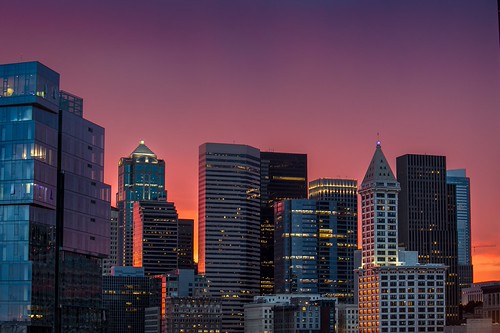
SR 520 service changes could mean more late evening service on Metro 255 and other Eastside routes
Several open houses are scheduled for the public to learn about new service on the SR 520 corridor. The first is on Wednesday evening in Kirkland, with others to follow through the rest of the month.
A particularly interesting opportunity is the open house at UW Husky Stadium on June 19. As well as the regular open house exhibits, staff members will guide tours of the bus-rail transfer experience.
Another way to participate is through the online survey which is open until June 30.
Last evening, Metro and Sound Transit released service change concepts for revised bus service on SR 520. This kicks off the second of three rounds of public input, including an online survey and several open houses in mid- to late June. Because these are service concepts, they do not describe capital improvements in Montlake or elsewhere could be combined with either service option.
Ten routes, six Metro (252, 255, 257, 268, 277, 311) and four Sound Transit (540, 541, 542, 545), are included. Two all-day routes, Metro 255 serving Kirkland-Seattle and Sound Transit 545 serving Redmond-Seattle, carry two-thirds of current ridership. As expected, many buses that currently serve downtown Seattle would be rerouted to UW station freeing resources that would otherwise be consumed in downtown congestion. Changes would take effect ahead of the closure of Convention Place Station, currently scheduled for Fall 2018.
Either alternative improves cross-lake service for most riders, excepting those who prioritize one seat rides to downtown over all else. But the reinvested service hours target different priorities, and many riders will consider their individual circumstances in figuring which option they prefer. A notable highlight of the proposals is that both options include new service between South Lake Union and the Eastside.
King County Metro rolled out two finalist options for an upcoming fare restructure Tuesday, as Zach reported:
* Option A: $2.75, any time, anywhere
* Option B: $2.50 off-peak, $3.00 peak
Senior, disability, youth, low-income, and Access fares would not change.
Previously, Metro had offered nine options for surveytakers’ priorities for the fare structure, using a dot exercise in which each taker could allocate 10 dots. The results came out thusly:
Regarding the #1 criterion among surveytakers, affordability, Metro is already on the cutting edge in the industry internationally, not just domestically, with its ORCA LIFT low-income fare card. It also gives out lots of tickets to human service agencies, which then give them out to clients who can’t afford any bus fare, in a program that is not so cutting-edge.
Mobile ticketing provides another option to avoid annoying your fellow passengers by fumbling cash. Perhaps it should be cheaper than paying with cash.
Part of the low-hanging fruit that could help transit move more smoothly when Convention Center Annex construction and other projects reduce throughput in the Central Business District would be streamlining the fare collection process on all buses.
Among the causes of longer dwell times are:
zone resets
fare disputes
passenger questions
failure to fully use rear doors
all the change fumbling, change fumbling, change fumbling, change fumbling, change fumbling
.
Both Metro and the monorail are collecting input on fare change proposals. Metro’s is focused on moving to a flat fare.
This author has long been a proponent of express fares based roughly on distance. However the likelihood that there will be no express bus routes entering downtown from the north end or I-90 after Lynnwood Link and East Link open changes the calculus. If only South King County express routes are left, trying to charge premium express fares to the portion of the county with the lowest average income seems pretty pointless. Moreover, with One Center City bus re-reroutes right around the corner, drastic actions have to be taken to keep buses moving. Fare simplification is overdue, and now desperately needed.
The current fares for the myriad downtown transit services require multiple cheat sheets. But for purposes of this analysis, we’ll ignore ferries and Sounder. Continue reading “One Center City Fare?”
ST 545 is among the routes that may be rerouted to UW station in Fall 2018 (Image: Atomic Taco)
King County Metro and Sound Transit have begun an outreach process to transit riders in the SR 520 corridor. Transit users and community members are invited to take a survey, running through April 2. Town halls will be held at University of Washington, in Redmond, and in Kirkland. This will be the first of several opportunities for public input planned as service proposals evolve.
Six Metro routes (252, 255, 257, 268, 277, 311) and six Sound Transit Express routes (ST 540, ST 541, ST 542, ST 545, ST 555, ST 556) may be affected. Generally, the agencies are interested in truncating most service on SR 520 to the University of Washington light rail station. Several of those routes already serve UW, so possible service changes go beyond simply truncating the remaining routes to downtown.
Candidate routes for truncation at UW serve Kirkland, Redmond and Woodinville. A final proposal is also expected to include more frequent service on many routes, along with more service earlier or later or on weekends. New service between the Eastside and South Lake Union will be considered.
The immediate impetus for service changes on SR 520 relates to several construction projects in central Seattle including the anticipated closure of the bus tunnel and Convention Place Station by the end of 2018. Absent other changes, bus performance through downtown will be slowed significantly. The One Center City proposal truncates many bus routes at rail stations outside of the downtown core. Some of the changes are temporary remedies until Link extensions to Northgate and Bellevue are open.
On the other hand, changes to SR 520 bus service offer permanent benefits to riders if executed well. Rail to downtown is faster and more reliable than buses on I-5 and surface streets. The service hour savings can be redeployed to more frequent service on Eastside buses or service to more places. But understandable concerns about the efficiency of bus to rail transfers at UW remain.
STB has done a deep dive into the street overhauls and bus service restructures being considered by the One Center City project. If you haven’t already done so, please Participate in the online open house, and Comment at the site. The comment form is just an open-form text box, and there are no surveys to complete.
Providing dedicated resources for enforcement of bus lanes and box blocking
Approving the proposed truncation of SR 520 Routes at UW Station
Improving the transfer environment at UW Station
Canceling or revising the proposed truncations of Routes 41 and 550
Approving the proposed West Seattle-First Hill restructure
We hope that you will take a few minutes to comment in favor of these principles and ideas. Comments are due by Friday. For more background, our posts on One Center City can be found here.
Crises inspire clarity and focus, and One Center City is no different. Our whirlwind of overlapping projects usually overwhelms us with extended process and mind-numbing rounds of design revisions and open houses. But Seattle in 2017 faces an historic convergence of projects that prevents us from such discursive luxuries. If we do nothing, we face 3 years of misery from 2018-2021 until Northgate Link saves the day. We have to act quickly and boldly.
In a Center City where 70% of commuters (and 95% of new commuters) do not drive alone, it should be crystal clear where our priorities lie. From Vision Zero, our Bike and Transit master plans, to our climate commitments, or to a cold utilitarian optimization of space, One Center City should head in only one direction. We must enhance transit, walking, and bicycling, and deemphasize peak auto access. Since the geographic constraints of our city are immutable, our dilemma is not ideological but geometric. As such, there are only two ways to make traffic better: transcend it through a more efficient use of space, or hope for recession, depopulation, and urban flight. Which would you prefer?
Ok, so we’re definitely not ready for the Big One. The ‘quake’ that was felt in Seattle on Monday was due to a single tanker truck, overturned and leaking butane at the I-90/I-5 interchange. At 10:30 Monday morning, the overturned truck caused a closure of I-5 in both directions that lasted until after 7pm. Crews worked to upright the tanker but also kept the scene clear for safety reasons.
20 months after we rage-laughed at ourselves on behalf of a salmon truck bringing us to our knees, this closure was far worse. Throw in a bitterly comical coup de grâce of thundersnow, and we truly had a meltdown for the ages. I-5 traffic was dead stopped for 8.5 hours, and southbound drivers’ only respite was to exit onto downtown surface streets, leading to intractable gridlock. Buses quickly fell behind, many of them two hours behind, the First Hill streetcar gave up and stopped operating on Broadway, and at one point there were twelve RapidRide D coaches bunched between Denny and Mercer in Lower Queen Anne. The West Seattle Water Taxi was turning people away on each run, and streets like Stewart were wall to wall with idling buses and cars. Normally placid side streets on Capitol Hill such as Belmont and Boylston – where I tell people I live in ‘the eye of the storm’ – were also gridlocked.
Aside from knock-on delays from tunnel bus unpredictability, Link light rail performed swimmingly, almost as if nothing at all was happening. We received two reports from Eastside commuters who had no trouble traveling from Kirkland to Capitol Hill at 4pm via bus and Link. Twitter was abuzz with frustrated souls wishing ST3 had been finished yesterday.
What was your experience like Monday? What did you notice? Below are a selection of reader-submitted photos.
Third Avenue. That car, typically, is about to ignore a Do Not Enter sign. Photo by Zack Heistand.
It’s time to make Third Avenue into Seattle’s first transit mall. Tomorrow. Or, at least, late next year, once the remaining buses have to leave the downtown tunnel. The City of Seattle should ban all* non-transit motor vehicles from Third, 24/7. Banning cars completely would:
Increase the bus capacity of Third
Speed up bus travel
Allow more efficient bus stop positioning
Improve pedestrian and bike safety
Make enforcement easier
Inconvenience very few car drivers
The ban has been warranted for several years, but will become far more important with the brave new world of no tunnel buses.
While Link light rail gets all the glory and gaudy annual ridership increases, Third remains the city’s busiest transit corridor in both trips per day (3,000) and ridership (likely about 125,000). Yet, as Zach reported last month, Metro, Sound Transit, and the City are not yet considering improvements to Third in the One Center City plan. Instead, they are proposing improvements to less-used corridors, along with major bus restructures that would force transfers — in some cases, with no return benefit. Improving Third by banning cars could allow Metro and Sound Transit to avoid the worst of these forced-transfer plans, while also improving the commute for a large majority of the 47 percent. (No, Mitt, not that 47 percent — the 47 percent of downtown commuters that use transit.)
The agencies should include a transit-only Third as a core piece of One Center City, and should take advantage of it by running as many buses there as it can possibly handle. More details about why, after the jump.